In 1941, after serving 8 months in prison for an assault on Leon Trotsky’s compound, world-renowned muralist and Stalinist David Alfaro Siqueiros was exiled to Chile under the supervision of the Mexican ambassador to paint a mural. His mural was to be created in the library of the Escuela Mexico, an elementary school gifted to the city of Chillán by Mexican president Cárdenas to aid with earthquake recovery.
Siqueiros was one of three prominent Mexican muralists who approached the subjects of national history, conflict, and class struggle to create a unified post-revolutionary national identity. Upon viewing the long and narrow room, Siqueiros envisioned a mural bending perspective, with an unbroken canvas allowing images to cross the room through the ceiling, transcending the walls. He applied rounded shapes to the corners and aesthetically heightened the ceiling, which allowed compositional forms to interact with each other from across the room, producing a cinematographic effect as the spectator’s perspective shifts.
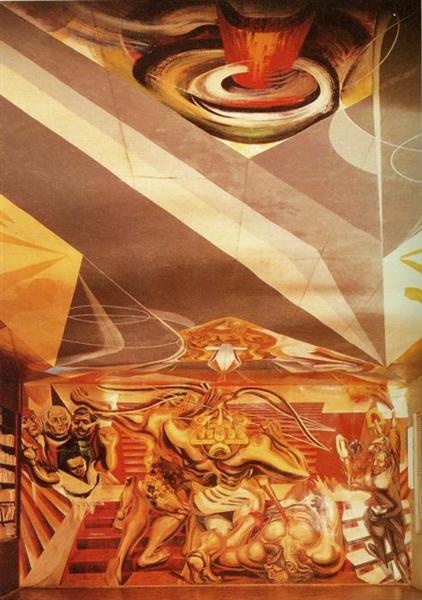
Siqueiros fills the Mexican wall with anti-colonial revolutionary thematic content, utilizing allegories and symbolic figures from the nation’s history. Standing tall on the steps of an Aztec temple is the central figure, emperor Cuauhtémoc, who defended Tenochtitlán from the Spanish. Cuauhtémoc aims his bow at the cross-dagger above, a symbol of colonial oppression. From the right and left, Hidalgo, Zapata, Morelos, and Juárez look on with fists clenched.
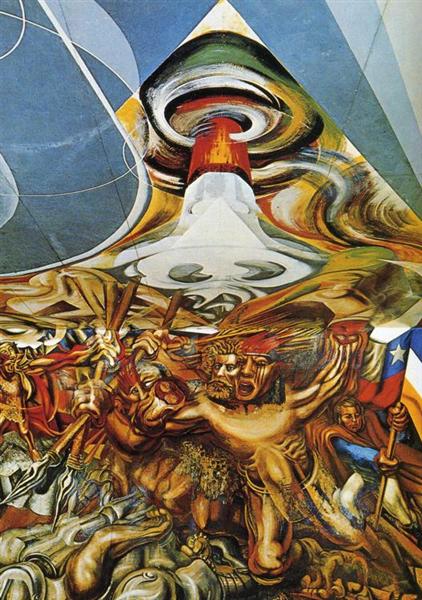
The physical and thematic nature of the mural is constructed to highlight the cohesive Latin American narrative of struggle. Siqueiros rounded the corners of the room to create an uninterrupted canvas. The volcano at the top of the Chilean wall and the fire atop the Mexican wall face each other across the abstract ceiling, symbolizing the nations’ respective national spirits. In the center of the Chilean wall, the figure of Galvarino, arms mutilated by the Spanish, appears in motion, alongside revolutionaries like O’Higgins and Lautaro.
While the subject matter depicted concerns history, Siqueiros notes that the mural is a “condemnation of invaders of all times.” Thus, the mural can be seen as a Latin American history of the continuing revolutionary struggle against Spanish imperialism and its legacies. Siqueiros engaged in a covert reframing, channeling animosity towards past colonization against contemporary fascism and the bourgeoisie.
- Christopher Fulton, "Siqueiros against the Myth: Paeans to Cuauhtémoc," Oxford Art Journal.
- Desmond Rochfort, Mexican Muralists: Orozco, Rivera, Siqueiros (New York: Universe, 1994).
- Philip Stein, Siqueiros: His Life and Works (New York: International Publishers, 1994).